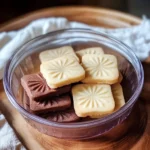
Ingredients
Scale
For the Korean Tea Cookies (Dasik):
-
- 1 cup Black Sesame Seed Powder (Heugimja Garu, 흑임자 가루), finely ground: This is a cornerstone ingredient for many Dasik variations, lending a deep, nutty, and slightly earthy flavor along with a beautiful black hue. Black sesame seeds are traditionally roasted before grinding to enhance their flavor and aroma. Ensure the powder is very finely ground for a smooth cookie texture. You can purchase pre-ground black sesame seed powder, or grind your own using roasted black sesame seeds and a spice grinder or high-powered blender.
-
- 1 cup Soybean Powder (Kong Garu, 콩가루), finely ground, roasted (optional): Soybean powder, often made from roasted soybeans, provides a subtly sweet, nutty, and slightly savory flavor profile. Roasting the soybean powder further enhances its nutty aroma and depth of flavor. Look for finely ground soybean powder, which is readily available in Korean grocery stores or online. If you are using unroasted soybean powder, you can lightly toast it in a dry pan over medium-low heat for a few minutes, stirring constantly, until fragrant and slightly golden, being careful not to burn it. Allow to cool completely before using.
-
- 1/2 cup Rice Flour (Bapsal Garu, 멥쌀가루), finely ground: Rice flour acts as a binder and adds a delicate, slightly chewy texture to the cookies. Korean rice flour, often made from short-grain rice, is traditionally used. Ensure the rice flour is very finely ground for a smooth cookie texture. You can find rice flour in most supermarkets or Asian grocery stores. Glutinous rice flour (Chapssal Garu, 찹쌀가루) is not typically used for Dasik as it can make the cookies too chewy and sticky.
-
- 1/4 cup Honey (or Korean Honey, Yut, 엿): Honey serves as the primary sweetener and binder in Dasik, lending a delicate sweetness and helping to hold the cookie mixture together. Korean honey, known as Yut (엿), is a traditional thick, sweet syrup made from grains and is often used in Korean confectionery for a more authentic flavor. If you cannot find Yut, good quality honey will work perfectly well. You can also use maple syrup or agave nectar as alternative sweeteners, but honey provides a classic flavor and texture.
-
- 1–2 tablespoons Hot Water (adjust as needed): Hot water is added gradually to help bring the dry ingredients together into a cohesive, moldable dough. The amount of water needed will depend on the dryness of your powders and the consistency of your honey. Add water a tablespoon at a time, mixing well after each addition, until the dough just comes together and can be easily pressed into molds.
Optional Ingredients for Flavor Variations:
-
- Green Tea Powder (Matcha, 녹차 가루): For Green Tea Dasik, substitute a portion of the soybean powder or rice flour with finely ground green tea powder (matcha). Start with 1-2 tablespoons and adjust to taste. Matcha will impart a slightly bitter, earthy, and vibrant green tea flavor and a beautiful green color.
-
- Five-Grain Powder (Okgara Garu, 오곡가루): For a more complex and nutritious Dasik, you can incorporate a five-grain powder blend, often available in Korean grocery stores. This blend typically includes rice, barley, black beans, sesame seeds, and millet, providing a variety of flavors and textures. Substitute a portion of the soybean powder or rice flour with five-grain powder.
-
- Pine Pollen Powder (Songhwa Garu, 송화 가루): For a very traditional and subtly floral flavor, you can add a small amount of pine pollen powder (Songhwa Garu). Pine pollen powder has a delicate, slightly sweet, and unique flavor. It is often used in very traditional Dasik recipes and is considered a prized ingredient. Use sparingly, as its flavor can be subtle.
-
- Cinnamon Powder (Gyesu Garu, 계수 가루): For a warm and aromatic variation, add a pinch of cinnamon powder (Gyesu Garu) to the dough. Cinnamon pairs well with the nutty flavors of sesame and soybean and adds a comforting spice note.
-
- Ground Nuts (Walnuts, Almonds, Pine Nuts), finely ground: For added texture and richness, you can incorporate finely ground nuts, such as walnuts, almonds, or pine nuts, into the Dasik dough. Substitute a portion of the soybean powder or rice flour with finely ground nuts.
Instructions
Step 1: Prepare the Dry Ingredients – Combining the Powders
This step involves combining the finely ground powders to create the base for your Dasik dough.
-
- Combine Dry Powders: In a medium mixing bowl, combine the black sesame seed powder, soybean powder, and rice flour. If you are using optional flavor additions like green tea powder, five-grain powder, or ground nuts, add them to the bowl at this stage and adjust the proportions of the base powders accordingly to maintain a total of approximately 2 cups of dry ingredients.
-
- Whisk to Combine: Whisk the dry ingredients together thoroughly to ensure they are evenly mixed and any clumps are broken up. This step ensures a consistent texture and flavor in your Dasik.
Step 2: Incorporate Honey and Water – Forming the Dough
This step involves gradually adding the honey and hot water to the dry ingredients to create a moldable dough.
-
- Add Honey: Pour the honey into the bowl with the dry ingredients.
-
- Mix Initially: Use a spoon or spatula to initially mix the honey into the dry powders. The mixture will initially be crumbly and dry.
-
- Gradually Add Hot Water: Start adding hot water, one tablespoon at a time. After each tablespoon of hot water, mix the dough thoroughly with your hands. Use your fingers to gently rub the mixture together and assess the consistency.
-
- Knead Gently: Continue adding hot water, one teaspoon at a time, and kneading gently until the dough just comes together into a cohesive ball. The dough should be moldable and slightly pliable, similar to playdough. It should not be sticky or too wet. The exact amount of hot water needed will vary depending on the dryness of your powders and the humidity. Be careful not to add too much water, as this can make the dough sticky and difficult to work with.
-
- Test Dough Consistency: To test the dough consistency, take a small pinch of dough and press it into a Dasik mold (or simply shape it with your fingers). If the dough holds its shape well and releases cleanly from the mold (or holds its shape when shaped by hand), the consistency is correct. If the dough is too crumbly, add a tiny bit more hot water (a few drops at a time). If the dough is too sticky, add a little more rice flour or soybean powder.
Step 3: Press into Molds – Creating Decorative Shapes
This is the fun and artistic step where you use Dasik molds to create the signature decorative shapes of Korean Tea Cookies.
-
- Prepare Molds: Ensure your Dasik molds are clean and dry. Lightly dust the inside of the molds with a little rice flour or soybean powder to prevent the dough from sticking, although this is often not necessary with traditional wooden molds if the dough consistency is correct.
-
- Take Small Portions of Dough: Take a small portion of the Dasik dough, about the size of a small marble or slightly larger, depending on the size of your molds.
-
- Press Dough into Molds: Place the dough portion into a Dasik mold and press it firmly and evenly into the mold cavity with your thumb or fingers. Ensure the dough fills all the details of the mold design.
-
- Invert and Release: Invert the mold over a parchment-lined baking sheet or plate. Gently tap the back of the mold to release the Dasik cookie. The cookie should release cleanly from the mold, retaining the imprinted design. If the cookie sticks, gently loosen it with a toothpick or small spatula.
-
- Repeat: Repeat steps 2-4 until all the dough is used up. Arrange the molded Dasik cookies on the parchment-lined baking sheet, leaving a little space between them.
Step 4: Air Dry or Bake – Setting the Cookies
Dasik are traditionally air-dried, but a very low temperature baking method can also be used to speed up the setting process and create a slightly firmer texture.
Option 1: Air Drying (Traditional Method):
-
- Air Dry at Room Temperature: Leave the molded Dasik cookies on the parchment-lined baking sheet at room temperature, uncovered, to air dry.
-
- Drying Time: Air dry for several hours, or preferably overnight (6-12 hours), until the cookies are firm to the touch and feel dry. The drying time will depend on the humidity and temperature of your environment. Air drying allows the cookies to set naturally and develop a slightly more delicate texture.
Option 2: Low Temperature Baking (Faster Method):
-
- Preheat Oven to Very Low Temperature: Preheat your oven to the lowest possible temperature setting, typically around 150-175°F (65-80°C). The oven should be just warm enough to gently dry the cookies, not bake them.
-
- Bake at Low Temperature: Place the baking sheet with the molded Dasik cookies in the preheated oven.
-
- Baking Time: Bake for 30-45 minutes, or until the cookies are firm to the touch and feel dry. Check the cookies periodically to ensure they are not browning or cracking. The goal is to gently dry them out, not bake them like regular cookies.
-
- Cool Completely: Remove the baking sheet from the oven and let the Dasik cookies cool completely on the baking sheet. They will firm up further as they cool.
Step 5: Store and Serve – Preserving Delicate Flavors
Proper storage is important to maintain the texture and flavor of your Dasik.
-
- Store in Airtight Container: Once the Dasik cookies are completely cooled and firm, store them in an airtight container at room temperature.
-
- Storage Duration: Dasik cookies will keep well at room temperature for several days, up to a week, depending on storage conditions and humidity.
-
- Serve with Tea: Serve Korean Tea Cookies, Dasik, as a delicate and elegant accompaniment to Korean teas, such as green tea (Nokcha, 녹차), barley tea (Boricha, 보리차), or roasted corn tea (Oksusu cha, 옥수수차). They are also wonderful enjoyed on their own as a light and subtly sweet treat.
Nutrition
- Serving Size: one normal portion
- Calories: 30-50
- Fat: 1.5-3 grams
- Carbohydrates: 5-8 grams
- Fiber: 0.5-1 gram
- Protein: 1-2 grams