
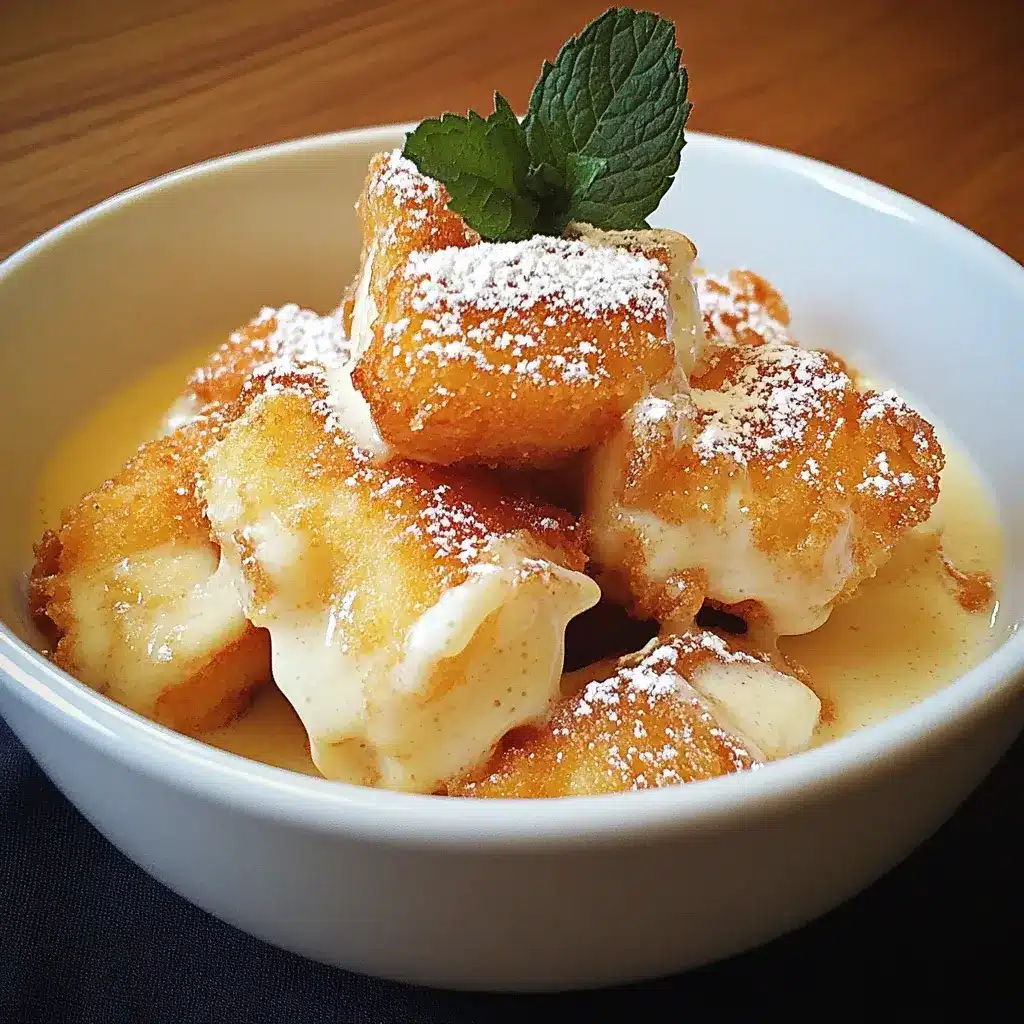

The first time I saw “Fried Milk” on a menu at a cozy tapas bar in Barcelona, I was completely bewildered. “You can’t fry a liquid,” I thought, picturing a chaotic, splattering mess. My curiosity, however, won out over my skepticism. What arrived at the table looked like golden, crispy cubes, dusted generously with cinnamon and sugar, looking deceptively simple. I took a bite, and the world slowed down. The exterior gave way with a delicate, satisfying crackle, revealing a center that was impossibly creamy, warm, and molten—like the most luxurious pudding I had ever tasted, infused with the subtle perfume of lemon and cinnamon. It was a moment of pure culinary magic. I had just experienced Leche Frita, and I was hooked. Recreating this “magic trick” at home became my next great mission. I discovered that the secret isn’t sorcery, but simple kitchen science. This recipe is the culmination of that mission, perfected to ensure that you can stun your own family and friends with this unbelievable dessert. It’s the dish I make when I want to see looks of pure astonishment, a dessert that starts as a conversation piece and ends in contented silence.
Leche Frita: The Ultimate Fried Milk Custard Recipe
This guide will demystify the process of making authentic Spanish Leche Frita, or Fried Milk. From creating the firm-yet-creamy custard to achieving that perfectly golden, non-greasy crust, you’ll learn all the secrets to mastering this incredible dessert.
Complete Ingredients List
The ingredient list is humble, but the synergy between them is what creates the magic. The ingredients are broken down into the custard itself and the coating for frying.
For the Milk Custard:
- 4 cups (1 liter) Whole Milk: For the best flavor and creamiest texture, whole milk is non-negotiable. Its higher fat content creates a richer, more luxurious custard.
- 1 cup (200g) Granulated Sugar: Provides the sweetness for the custard base.
- 3/4 cup (90g) Cornstarch: This is the key thickening agent. It’s what allows the milk to set into a firm, sliceable block that can withstand frying.
- 1 Cinnamon Stick: Infuses the milk with a warm, woody spice flavor that is classic to this dish.
- The Peel of 1 Lemon: Use a vegetable peeler to get wide strips of peel, avoiding the bitter white pith. This imparts a bright, fragrant citrus note that cuts through the richness.
- 1/2 teaspoon Pure Vanilla Extract: Adds a layer of aromatic depth.
- 2 Large Egg Yolks (optional, but recommended): While not strictly traditional in all regional recipes, adding egg yolks creates a richer, more custardy flavor and a slightly sunnier color.
For the Breading and Frying:
- 1 cup All-Purpose Flour: For the first layer of coating.
- 2 Large Eggs, lightly beaten: Acts as the binder for the breading.
- Neutral Oil for frying (such as Canola, Sunflower, or Vegetable Oil): You’ll need about 2-3 inches of oil in your pot or skillet.
- 1/2 cup Granulated Sugar, for dusting
- 1 tablespoon Ground Cinnamon, for dusting
Step-by-Step Instructions
The process can be broken down into three main stages: making and chilling the custard, breading the custard cubes, and finally, frying them to golden perfection.
Stage 1: Prepare and Chill the Custard (Do this ahead of time)
- Infuse the Milk: In a medium saucepan, combine 3 cups of the whole milk, the granulated sugar, the cinnamon stick, and the lemon peel. Place it over medium heat. Bring the mixture to a gentle simmer, stirring occasionally to dissolve the sugar. Once it simmers, turn off the heat, cover the pot, and let the aromatics infuse for at least 20 minutes.
- Create the Cornstarch Slurry: While the milk is infusing, in a separate medium bowl, pour the remaining 1 cup of cold milk. Add the cornstarch to the cold milk and whisk vigorously until it is completely smooth and free of lumps. This mixture is called a slurry. If you are using the optional egg yolks, whisk them into this slurry now until fully incorporated.
- Combine and Thicken: Remove the cinnamon stick and lemon peels from the infused milk with a slotted spoon. Turn the heat back on to medium. Just before the milk begins to simmer again, slowly pour the cornstarch slurry into the saucepan while whisking constantly.
- Cook Until Very Thick: Continue to cook, whisking constantly and scraping the bottom and corners of the pan to prevent scorching. The mixture will begin to thicken dramatically. Keep cooking and whisking for about 5-7 minutes, until it becomes a very thick, pudding-like paste that pulls away from the sides of the pan as you stir. It should be much thicker than a standard pudding. Once thick, stir in the vanilla extract.
- Chill Until Firm: Lightly grease an 8×8 inch glass or ceramic baking dish with a neutral oil or butter. Pour the hot custard mixture into the dish and use a spatula to spread it into an even layer. Let it cool on the counter for about 30 minutes. Then, cover it with plastic wrap, pressing the wrap directly onto the surface of the custard to prevent a skin from forming.
- Refrigerate: Place the dish in the refrigerator to chill for at least 4 hours, or preferably overnight. The custard must be completely cold and very firm before you can proceed. This step cannot be rushed.
Stage 2: Bread the Custard Cubes
- Prepare for Frying: When you’re ready to fry, pour your frying oil into a deep, heavy-bottomed pot or high-sided skillet until it is about 2-3 inches deep. Begin heating it over medium-high heat. You’re aiming for a temperature of 350-360°F (175-180°C).
- Set Up Your Breading Station: You’ll need three shallow dishes.
- Dish 1: The all-purpose flour.
- Dish 2: The 2 beaten eggs.
- Dish 3: Set this aside for the end. In this dish, mix the 1/2 cup of sugar and 1 tablespoon of ground cinnamon for the final coating.
- Cut the Custard: Carefully run a knife around the edge of the baking dish and invert the firm custard block onto a clean cutting board. Cut the block into uniform squares or rectangles, about 1.5 to 2 inches in size.
- Coat the Cubes: Working with one cube at a time, gently dredge it in the flour, shaking off any excess. Next, dip it into the beaten egg, ensuring it’s fully coated. Let any excess egg drip off.
Stage 3: Fry to Golden Perfection
- Check the Oil Temperature: If you don’t have a thermometer, drop a tiny bit of the egg-and-flour batter into the oil. If it sizzles vigorously and turns golden brown in about 30-45 seconds, the oil is ready.
- Fry in Batches: Carefully place 3-4 breaded custard cubes into the hot oil. Do not overcrowd the pan, as this will lower the oil temperature and result in greasy, soggy fried milk.
- Fry Until Golden: Fry for about 1-2 minutes per side, turning gently with tongs or a spider strainer, until all sides are a deep golden brown and crispy. The custard is already cooked, so you are just focused on creating the crispy outer shell.
- Drain and Dust: Remove the fried cubes from the oil and place them on a wire rack to drain for a moment. While they are still hot, immediately transfer them to the cinnamon-sugar mixture and toss gently to coat all sides completely.
- Serve Immediately: Arrange the hot, coated fried milk cubes on a platter and serve immediately for the best experience.
Nutrition Facts
- Servings: Makes about 16-20 cubes
- Calories per serving (1 cube): Approximately 120-150 kcal (This is an estimate and can vary based on cube size and oil absorption.)
Preparation Time
- Active Time: 30 minutes
- Chilling Time: 4 hours (minimum)
- Total Time: Approximately 4 hours and 30 minutes
How to Serve Your Fried Milk
Leche Frita is spectacular on its own, but it can also be dressed up for a truly show-stopping dessert presentation.
- The Traditional Way:
- Served hot and fresh, piled on a platter, and generously coated in cinnamon sugar. This is perfection in its simplest form.
- With a Sauce Drizzle:
- Chocolate Sauce: A drizzle of rich, dark chocolate sauce provides a lovely bitter contrast to the sweet custard.
- Caramel or Dulce de Leche: Leaning into the caramel notes of the fried exterior, a drizzle of warm caramel sauce is pure decadence.
- Berry Coulis: A bright, tart raspberry or strawberry coulis cuts through the richness beautifully and adds a vibrant splash of color.
- A La Mode:
- Serve a few warm cubes alongside a scoop of high-quality vanilla bean or cinnamon ice cream. The contrast between the hot, crispy cubes and the cold, creamy ice cream is sensational.
- With Fresh Fruit or Cream:
- Arrange the cubes on a plate with fresh berries (raspberries, blueberries, or sliced strawberries).
- Add a dollop of freshly whipped cream or a dusting of powdered sugar for an elegant finish.
Additional Tips for Success
- Patience is the Secret Ingredient: The most critical step in this entire recipe is chilling the custard until it is completely firm. If you try to cut and fry a semi-set, lukewarm custard, it will fall apart in the hot oil. Give it the full 4 hours, or better yet, make it the day before.
- Master Your Oil Temperature: The second most critical step is frying at the correct temperature (350-360°F / 175-180°C). If the oil is too cool, the crust will absorb too much oil and become greasy. If the oil is too hot, the crust will burn before it becomes golden and crispy. Use a thermometer for best results.
- Whisk Like You Mean It: When making the custard, you must whisk constantly and vigorously, especially after adding the cornstarch slurry. This prevents lumps from forming and stops the bottom from scorching, ensuring a silky-smooth final product.
- The Double Dusting Technique: For an extra-crispy crust, you can use the double-dredge method. After dipping in the egg, dredge the cube back into the flour for a second time before placing it back into the egg one last time. This creates a thicker coating that gets exceptionally crunchy.
- Flavor Variations: While lemon and cinnamon are traditional, feel free to experiment! Infuse the milk with orange peel instead of lemon. Add a star anise pod along with the cinnamon stick for a different spice profile. Swap the vanilla extract for almond extract for a nutty twist.
Frequently Asked Questions (FAQ)
1. Can I make Fried Milk gluten-free?
Yes, this recipe is easily adapted for a gluten-free diet. For the breading, simply substitute the all-purpose flour with a good quality gluten-free all-purpose flour blend. The cornstarch in the custard is already naturally gluten-free.
2. Can I bake or air-fry this instead of deep-frying?
While you can try, the result will be very different and not the authentic Leche Frita experience. Deep frying creates a distinct, shatteringly crisp crust that inflates slightly around the custard.
- Air Fryer: To try it in an air fryer, spray the breaded cubes generously with cooking oil spray. Air fry at around 375°F (190°C) for 8-10 minutes, flipping halfway, until golden. The crust will be drier and more like a baked shell.
- Baking: Baking will produce the least crispy result. It will be more of a warm, breaded custard square.
3. Why didn’t my milk custard set properly?
The most common reason for a custard that doesn’t set firmly is that it wasn’t cooked long enough after the cornstarch was added. The cornstarch mixture needs to be cooked at a boil/thick bubble for several minutes to fully activate its gelling properties. You’re looking for a texture that is noticeably thicker than a standard pudding, almost like a thick paste.
4. What is the difference between Spanish Leche Frita and Italian Crema Fritta?
They are very similar “fried custard” desserts and likely share a common origin. The main difference is typically in the ingredients. Italian Crema Fritta is almost always made with a higher proportion of egg yolks, making it a richer, more yellow, and more distinctly “custardy” dessert. Spanish Leche Frita is often simpler, relying more heavily on just milk and cornstarch, resulting in a whiter, more “milky” flavor, though many modern recipes (like this one) incorporate yolks for richness.
5. How do I store and reheat leftovers?
Fried Milk is unequivocally best when eaten hot and fresh, right after frying. The crispy crust will soften considerably upon refrigeration. If you do have leftovers, store them in an airtight container in the fridge for up to 2 days. To reheat, the best method is in an air fryer or a toaster oven at 350°F (175°C) for a few minutes to try and re-crisp the exterior. Microwaving is not recommended as it will make the crust soggy.
Fried Milk Custard recipe
Ingredients
For the Milk Custard:
-
4 cups (1 liter) Whole Milk: For the best flavor and creamiest texture, whole milk is non-negotiable. Its higher fat content creates a richer, more luxurious custard.
-
1 cup (200g) Granulated Sugar: Provides the sweetness for the custard base.
-
3/4 cup (90g) Cornstarch: This is the key thickening agent. It’s what allows the milk to set into a firm, sliceable block that can withstand frying.
-
1 Cinnamon Stick: Infuses the milk with a warm, woody spice flavor that is classic to this dish.
-
The Peel of 1 Lemon: Use a vegetable peeler to get wide strips of peel, avoiding the bitter white pith. This imparts a bright, fragrant citrus note that cuts through the richness.
-
1/2 teaspoon Pure Vanilla Extract: Adds a layer of aromatic depth.
-
2 Large Egg Yolks (optional, but recommended): While not strictly traditional in all regional recipes, adding egg yolks creates a richer, more custardy flavor and a slightly sunnier color.
For the Breading and Frying:
-
1 cup All-Purpose Flour: For the first layer of coating.
-
2 Large Eggs, lightly beaten: Acts as the binder for the breading.
-
Neutral Oil for frying (such as Canola, Sunflower, or Vegetable Oil): You’ll need about 2-3 inches of oil in your pot or skillet.
-
1/2 cup Granulated Sugar, for dusting
-
1 tablespoon Ground Cinnamon, for dusting
Instructions
Stage 1: Prepare and Chill the Custard (Do this ahead of time)
-
Infuse the Milk: In a medium saucepan, combine 3 cups of the whole milk, the granulated sugar, the cinnamon stick, and the lemon peel. Place it over medium heat. Bring the mixture to a gentle simmer, stirring occasionally to dissolve the sugar. Once it simmers, turn off the heat, cover the pot, and let the aromatics infuse for at least 20 minutes.
-
Create the Cornstarch Slurry: While the milk is infusing, in a separate medium bowl, pour the remaining 1 cup of cold milk. Add the cornstarch to the cold milk and whisk vigorously until it is completely smooth and free of lumps. This mixture is called a slurry. If you are using the optional egg yolks, whisk them into this slurry now until fully incorporated.
-
Combine and Thicken: Remove the cinnamon stick and lemon peels from the infused milk with a slotted spoon. Turn the heat back on to medium. Just before the milk begins to simmer again, slowly pour the cornstarch slurry into the saucepan while whisking constantly.
-
Cook Until Very Thick: Continue to cook, whisking constantly and scraping the bottom and corners of the pan to prevent scorching. The mixture will begin to thicken dramatically. Keep cooking and whisking for about 5-7 minutes, until it becomes a very thick, pudding-like paste that pulls away from the sides of the pan as you stir. It should be much thicker than a standard pudding. Once thick, stir in the vanilla extract.
-
Chill Until Firm: Lightly grease an 8×8 inch glass or ceramic baking dish with a neutral oil or butter. Pour the hot custard mixture into the dish and use a spatula to spread it into an even layer. Let it cool on the counter for about 30 minutes. Then, cover it with plastic wrap, pressing the wrap directly onto the surface of the custard to prevent a skin from forming.
-
Refrigerate: Place the dish in the refrigerator to chill for at least 4 hours, or preferably overnight. The custard must be completely cold and very firm before you can proceed. This step cannot be rushed.
Stage 2: Bread the Custard Cubes
-
Prepare for Frying: When you’re ready to fry, pour your frying oil into a deep, heavy-bottomed pot or high-sided skillet until it is about 2-3 inches deep. Begin heating it over medium-high heat. You’re aiming for a temperature of 350-360°F (175-180°C).
-
Set Up Your Breading Station: You’ll need three shallow dishes.
-
Dish 1: The all-purpose flour.
-
Dish 2: The 2 beaten eggs.
-
Dish 3: Set this aside for the end. In this dish, mix the 1/2 cup of sugar and 1 tablespoon of ground cinnamon for the final coating.
-
-
Cut the Custard: Carefully run a knife around the edge of the baking dish and invert the firm custard block onto a clean cutting board. Cut the block into uniform squares or rectangles, about 1.5 to 2 inches in size.
-
Coat the Cubes: Working with one cube at a time, gently dredge it in the flour, shaking off any excess. Next, dip it into the beaten egg, ensuring it’s fully coated. Let any excess egg drip off.
Stage 3: Fry to Golden Perfection
-
Check the Oil Temperature: If you don’t have a thermometer, drop a tiny bit of the egg-and-flour batter into the oil. If it sizzles vigorously and turns golden brown in about 30-45 seconds, the oil is ready.
-
Fry in Batches: Carefully place 3-4 breaded custard cubes into the hot oil. Do not overcrowd the pan, as this will lower the oil temperature and result in greasy, soggy fried milk.
-
Fry Until Golden: Fry for about 1-2 minutes per side, turning gently with tongs or a spider strainer, until all sides are a deep golden brown and crispy. The custard is already cooked, so you are just focused on creating the crispy outer shell.
-
Drain and Dust: Remove the fried cubes from the oil and place them on a wire rack to drain for a moment. While they are still hot, immediately transfer them to the cinnamon-sugar mixture and toss gently to coat all sides completely.
-
Serve Immediately: Arrange the hot, coated fried milk cubes on a platter and serve immediately for the best experience.
Nutrition
- Serving Size: one normal portion
- Calories: 120-150 kcal